
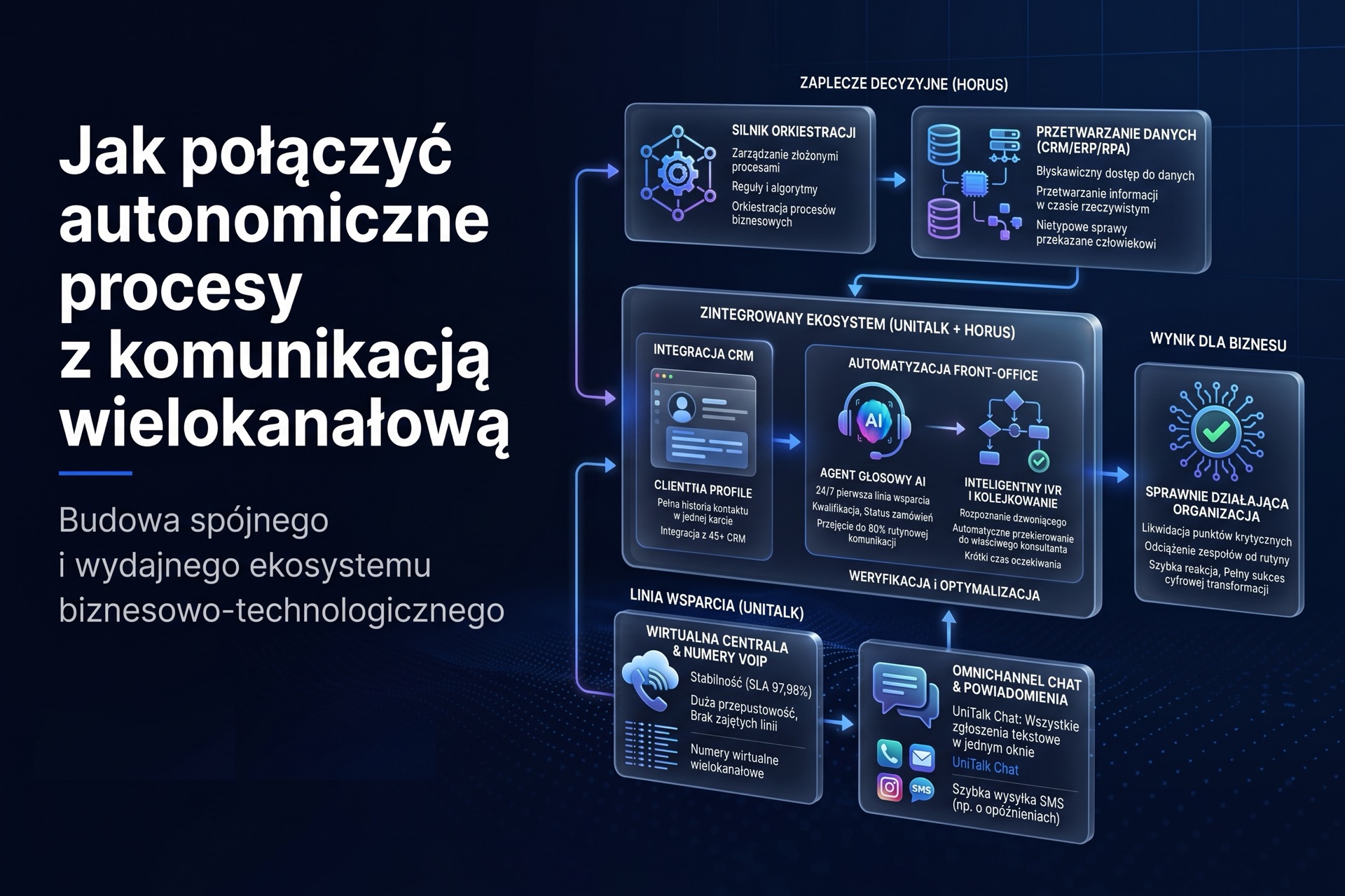
Many large organisations automate their internal systems successfully. Documents move digitally, key business decisions are made by algorithms in fractions of a second, and RPA robots shuttle data between CRM and ERP systems in the background. Yet at the start of that optimised chain there is often a critical point: communication with the customer. An autonomous system can process a new order, a complaint or a service request in three seconds — but without stable VoIP telephony, all that speed loses its point.
What are autonomous processes in enterprise architecture?
Automation today is far more than simple bots that copy data around or reply on chat. In modern companies we are talking about advanced systems that can manage complex processes end to end on their own, keeping track of every stage and every business dependency.
In e-commerce, such a system can handle a product return in full: from verifying the parcel with the courier, through issuing the refund, to updating stock levels. In logistics, it automatically manages transport delays, instantly recalculating delivery times and notifying customers. In manufacturing, it can monitor inventory on its own and reorder materials that are running out, protecting the plant from costly downtime.
All of this rests on clear rules. When the algorithm hits an unusual problem, it hands the decision smoothly to a human. Technology takes on the repetitive routine, and the expert steps in only where their experience and judgement are genuinely needed.
Multichannel communication as part of modern processes
Even the most advanced automation needs a stable intermediary between the company and the person on the other side. Wherever systems manage e-commerce returns or logistics delays on their own, reliable VoIP telephony is essential. Communication always starts with the customer dialling the company’s number, and running a large helpline requires multichannel numbers with enough capacity for every customer to get through without waiting long minutes on a busy line.
Virtual numbers from UniTalk run within an intelligent cloud PBX that operates in the cloud and manages all voice traffic, which gives you a guarantee of stability. Whether your online shop takes hundreds of orders and complaints at once, or a factory urgently reorders missing materials, every customer and partner always gets through.
Modern communication is not only voice, though — it is full multichannel coverage. Today’s customer picks whatever is most convenient: they call, write on the website chat, send messages on Instagram, or email. Instead of forcing your team to switch between dozens of tabs, UniTalk Chat gathers all those text enquiries in a single window. And when background processes change — a shipment is delayed, say — quickly sending an SMS to notify the customer about the delivery time becomes crucial. Whether you send a single transactional notification or launch a mass campaign, the message reaches the recipient in just a few seconds.
But what if the customer, after receiving an SMS, sends an email regardless of the message topic, and a moment later calls the helpline to ask for details? The key to the multichannel approach UniTalk offers is the ability to integrate the cloud PBX with one of more than 45 CRM systems. As a result, every interaction is recorded on a single customer card. The agent picking up the phone immediately sees who is calling and the history of the previous contact.
Connecting autonomous processes with multichannel communication
Process automation usually runs backstage, where — thanks to technologies for instant data access and orchestration engines — the system processes information and makes business decisions in real time. Combining those autonomous processes with modern communication tools such as virtual numbers and a cloud PBX creates a coherent whole and forms a solid foundation for an organisation that runs smoothly.
Innovation need not stop at back-end processes, though, because communication with customers can be effectively automated too. With UniTalk — a complete solution for managing customer communication — you can design the entire contact process to fit your business needs exactly, whatever your industry. A customer calls customer service, the system recognises them immediately and automatically routes them to the agent who already handled their case. The employee knows straight away who they are talking to, and the customer does not have to repeat their story from scratch. Meanwhile, an intelligent voice menu (IVR) and queueing send new callers straight to the right department, without the irritation of waiting on a busy line. And the first point of contact on such a call does not have to be a live human at all.
Instead of forcing your team to answer the same repetitive questions, you can hand the front line of service to an AI Voice Agent. It is a virtual employee that works 24 hours a day, 7 days a week and can take over as much as 80% of routine communication. The agent qualifies the customer immediately, resolves simple problems, checks order status, and passes on to your experts only the cases that genuinely require their experience.
Process optimisation also covers the conversations themselves, both in sales and in customer service. When a call finally reaches a live agent, AI-based speech analytics transcribes the conversation and scores it against defined parameters — recognising key elements of the dialogue, next steps, keywords, agent mistakes and much more. Listening to recordings manually and in samples stops being necessary, because this solution automatically analyses 100% of calls. That makes the call review process fully measurable. The system also picks out the best conversations on its own, which can then serve as ready-made training material for the whole team. At the same time, the technology monitors caller sentiment continuously, and when a conversation scores poorly it immediately sends the analysis to the department head or another responsible person — letting them react instantly, before the company loses a contract or a customer.
Summary: where Horus expertise meets UniTalk technology
Fully successful digital transformation requires blurring the line between the back office the customer never sees and the first line of support. Even the fastest back-office algorithms lose their business value if stable, multichannel communication is missing at the end of the chain.
Using tools from UniTalk such as the cloud PBX and UniTalk Chat, a company gains ready-made, fully scalable contact channels. The system collects voice calls and text enquiries in one convenient working environment. With a stability guarantee of 97.98% (SLA), intelligent call routing and an open API, the solution adapts to company processes instantly. Your team works without technical downtime, and customers do not bounce off busy lines.
Horus solutions, in turn, act as the intelligent decision-making backbone that makes business processes more efficient and better organised around the systems and applications in your IT architecture. Pairing advanced process orchestration with modern communication technology removes the critical points and builds an environment where technology genuinely takes weight off your teams. Build an ecosystem in your company that supports your business.
Milena Baran, Content Marketing Specialist at UniTalk.