
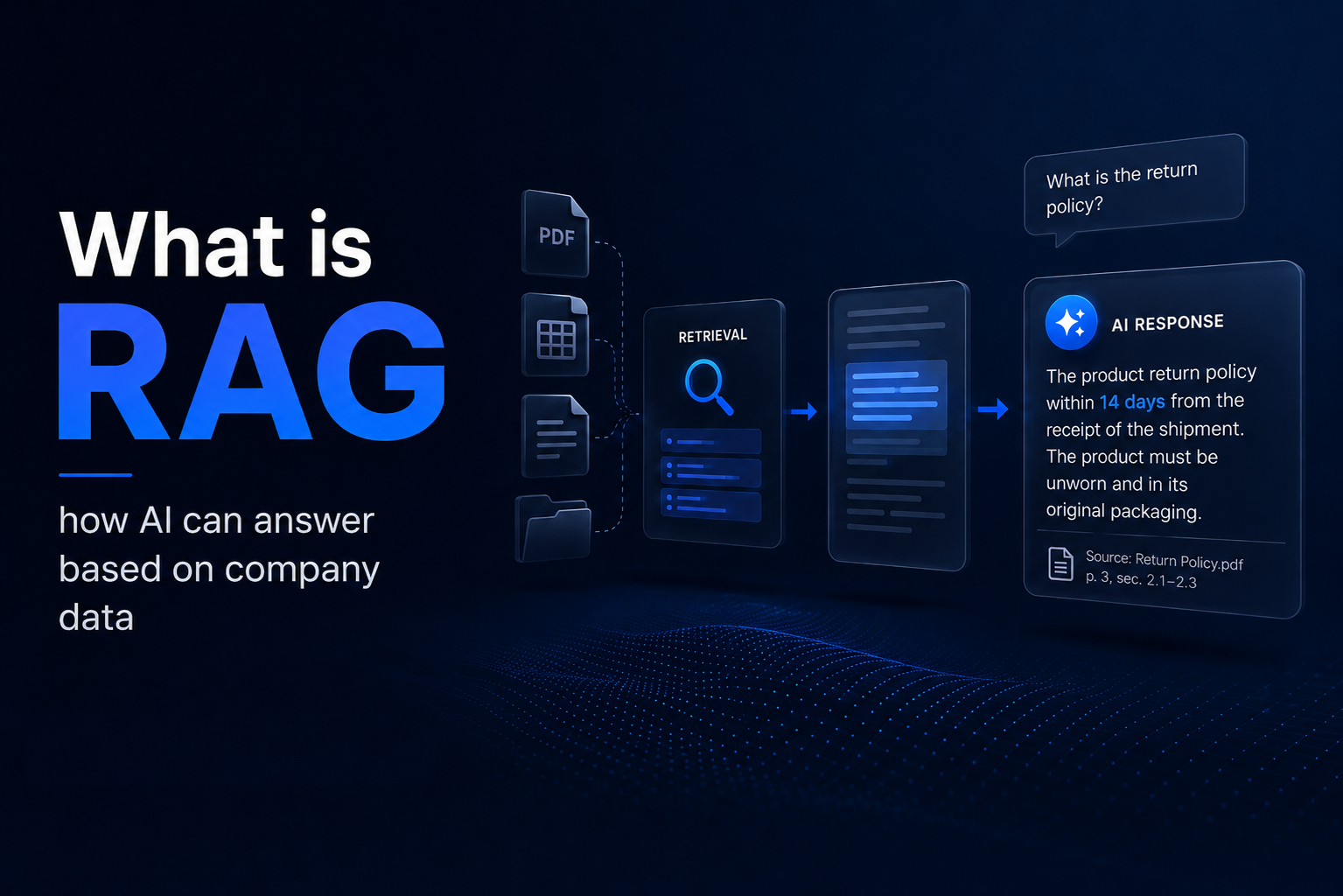
A company rolls out an AI assistant for customer support. The first few questions go smoothly — the model answers fluently, politely, and specifically. Then, on the fifth question, someone asks about a promotion that ended a month ago. The assistant says it’s still running. With full confidence.
A language model doesn’t automatically verify facts — it simply predicts which words most likely come next. When it lacks the information, it can generate a fluent, credible-sounding, and sometimes simply false answer. No prompt can supply the model with information it doesn’t have.
The model also has no automatic access to the company’s current state: a new price list, a changed procedure, or internal documentation.
RAG, or Retrieval-Augmented Generation, is one technique for supplying the model with additional information exactly when it’s needed. It works best when the right knowledge has to be found within a set of documents or other content.
What RAG is
The simplest analogy: imagine an expert who’s great at analyzing information but needs source material before answering. Someone searches the documents for the most relevant excerpts, and only then does the expert respond.
The system performs three basic steps:
- Retrieval — it retrieves the information best matching the question from a knowledge base prepared in advance: documents have to be collected, split into chunks, and indexed. It may use semantic search (by meaning rather than exact words), classic keyword search, or both methods at once.
- It adds the retrieved excerpts to the user’s question and passes the whole thing to the model — hence “augmented” in the name.
- Generation — it generates an answer using the supplied excerpts as its source of knowledge.
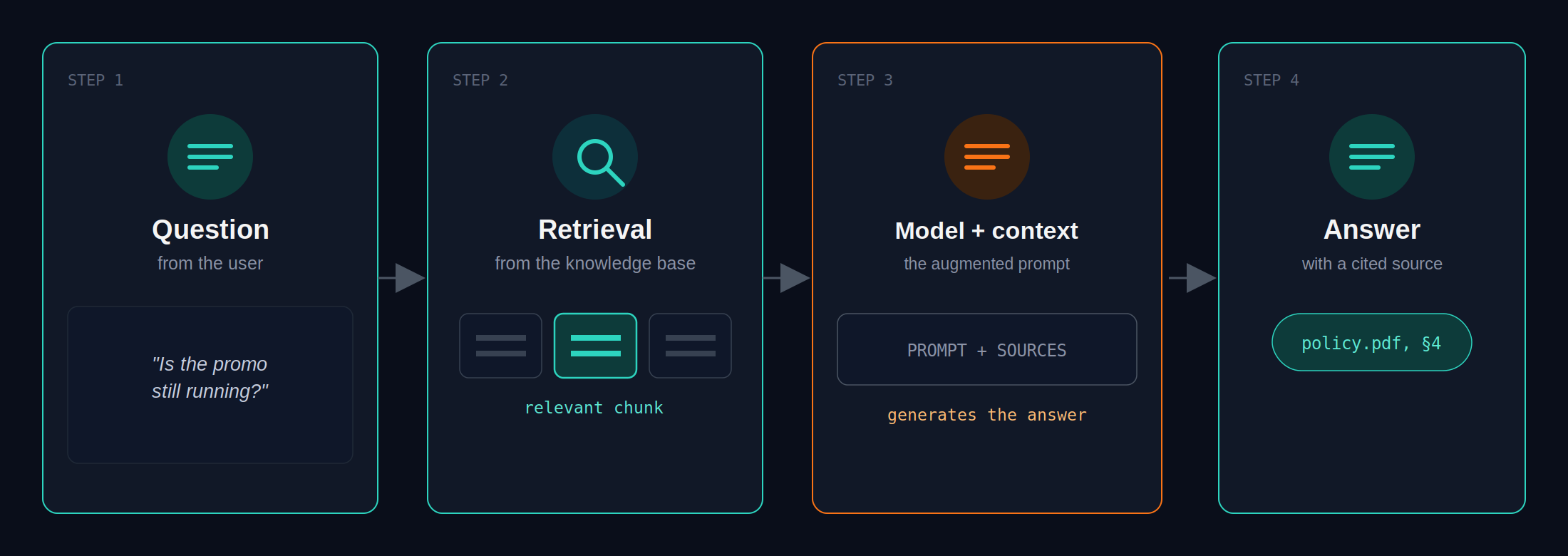
In simpler systems, retrieval runs on every question; in more advanced ones, the model decides whether and what to search for.
The assistant from the start of this article would, this way, receive the current promotion terms and the information that the promotion has ended. A well-designed system will also point to the document and excerpt it based its answer on, so the user can verify it.
RAG is not fine-tuning. Fine-tuning is mainly used to shape how a model behaves, while RAG supplies it with up-to-date knowledge from specified sources. The two approaches can complement each other, but they solve different problems.
What RAG is actually good for
The most natural use cases appear wherever an answer needs to be grounded in knowledge stored in company content:
- Internal knowledge base — an employee asks about a procedure instead of manually searching the intranet or a document catalog.
- Customer support — the assistant explains the current price list, terms, product documentation, or return policy based on the right sources.
- Technical documentation — the system answers a question based on hundreds of pages of manuals and points to the source.
- Legal documents and procedures — RAG helps locate the right clauses in contracts, terms of service, and internal policies.
It does not, however, replace systems that hold the company’s current state.
RAG is not the only way to work with company data
In a corporate AI system, different kinds of information call for different mechanisms. RAG is not the default way to fetch the current state from a business system.
If a user asks, “What’s the return procedure?”, the assistant can look up the relevant policy and explain it based on the source. That’s a natural use case for RAG.
If they ask, “Where’s my order #123?”, what’s needed is the current record from the order-management system — the assistant should reach for an integration that returns the status of that specific order. Finding similar-sounding text in documents won’t guarantee either freshness or certainty that the data belongs to the right person.
The same principle applies to stock levels, a customer’s balance, a price calculated for a specific account, or a booking. Such tasks require integration with the source system, the right permissions, and — for operations that change data — often confirmation before execution.
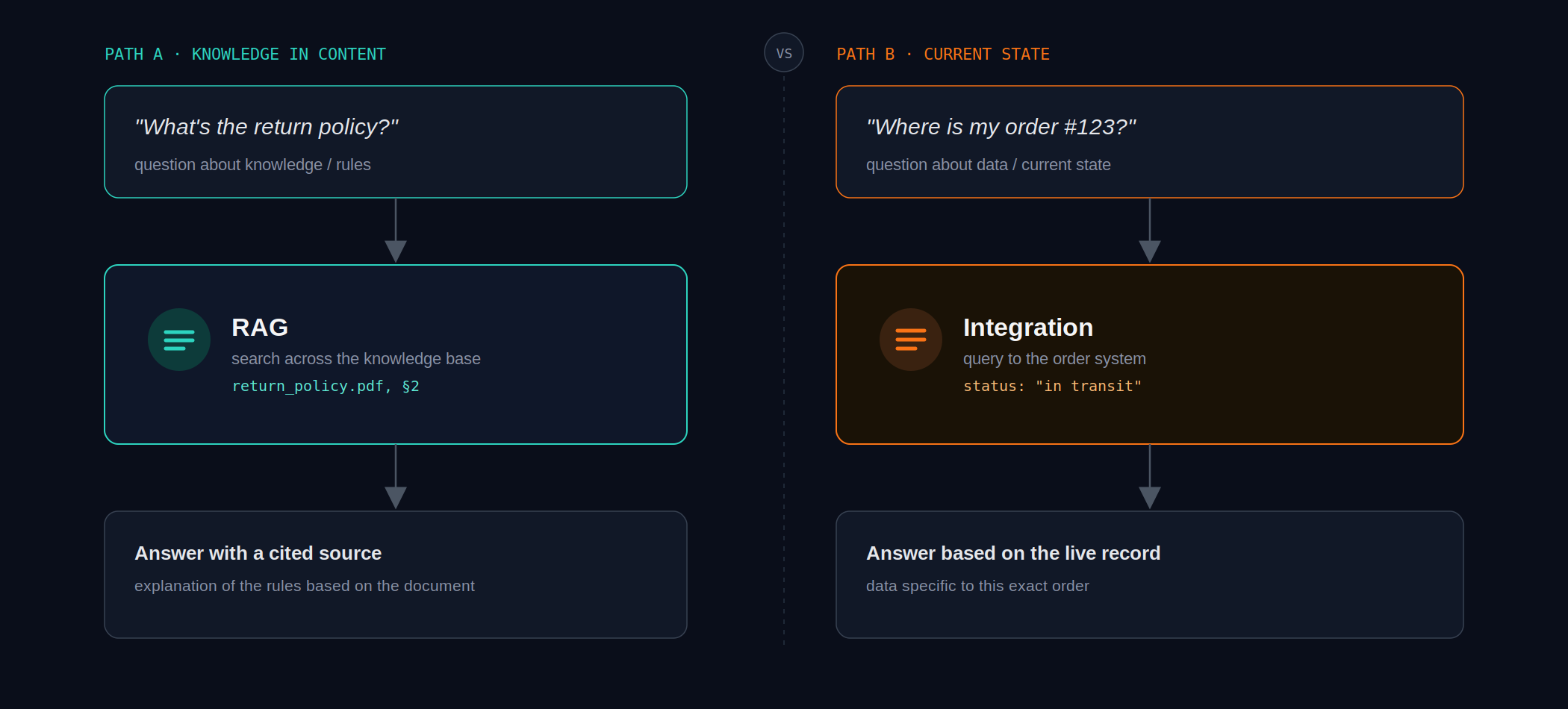
In practice, the two approaches work together. The same assistant might fetch a shipment’s status from the order system and use RAG to find the complaint-handling rules and explain what that status means.
So the key question isn’t “Do we have company data?” but “Do we need to find and interpret knowledge in content, or read current state, or perform an action in a system?”
RAG doesn’t eliminate hallucinations
It’s worth tempering one expectation right away. RAG reduces one of the main causes of wrong answers — missing information in context — but it doesn’t stop the model from being wrong. The system might find the wrong document, skip an important excerpt, or the model might misinterpret correctly retrieved information — and a citation under the answer can look right only on the surface if the model generates it itself instead of pointing to excerpts that were actually retrieved.
That’s why a mature RAG system should ground its answer in the supplied sources, be able to decline to answer when there isn’t enough data, and let you check where a given piece of information came from.
RAG doesn’t remove hallucinations, but it creates much better conditions for keeping them in check.
Why deploying RAG isn’t “plug in the documents and it works”
The three steps of RAG sound simple, which can suggest that all you need to do is dump documents into a database, connect a model, and the project is done. In practice, that’s exactly where the real work begins.
The first prototype — ten well-prepared documents, a handful of sample questions — works almost every time and looks great in a demo. Production, with thousands of documents, multiple data sources, frequent updates, and users with different permission levels, is an entirely different problem.
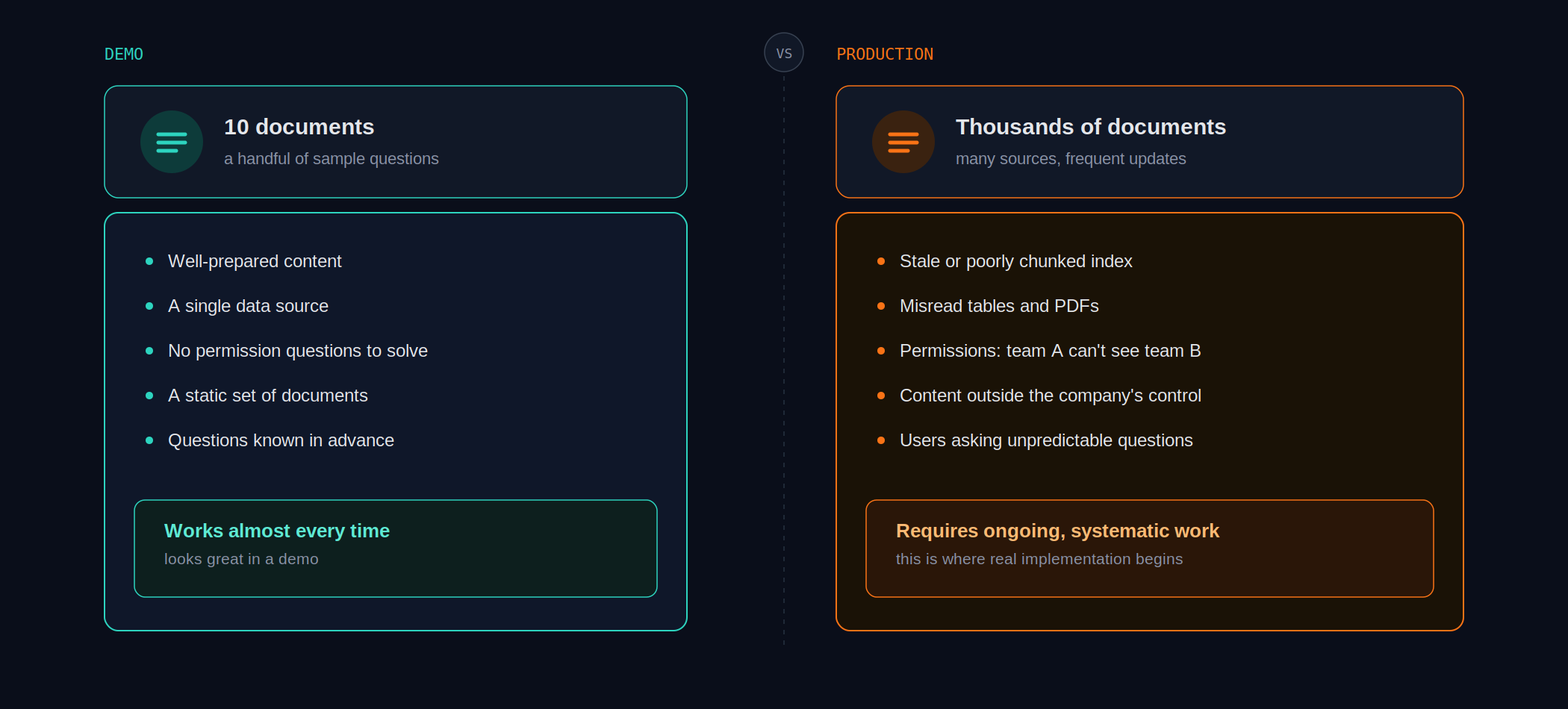
A document in the index can be outdated — RAG is only as current as the index is kept up to date. The tool reading a file can misinterpret a table or a PDF. Content can get split into chunks badly. The search engine can find text that’s linguistically similar but doesn’t actually answer the question. The system can also return several mediocre results instead of one good one.
Then there are permissions. If an employee in department A doesn’t have access to department B’s documents, the AI assistant can’t use them to generate an answer either. A separate issue is content the company doesn’t fully control: customer tickets, files from contractors, web pages. An instruction hidden inside a document can influence the assistant’s behavior. Access control and trust in sources aren’t an add-on to RAG — in a company system, they’re one of its basic requirements.
The model is often not the biggest problem
When answers are weak, the natural reaction is to switch to a bigger model. Sometimes that helps, but very often a bigger improvement comes from better document preparation, a different chunking approach, combining semantic search with classic keyword search, or re-ranking the retrieved excerpts by relevance (so-called reranking).
That’s why, when diagnosing quality, it’s worth separating two questions:
- Did the system find the right information?
- Did the model use it correctly?
If retrieval returned the wrong document, even a great model has limited options. If it returned the right one and the answer is still wrong, the cause is usually in the instructions given to the model, in a badly trimmed excerpt, or in conflicting information across several documents. The two cases are fixed differently.
How do you know RAG is working well
In a demo, it’s easy to conclude a system “looks good” because a few answers sound sensible and the project feels finished. But “sounds sensible” isn’t a metric.
A production RAG system needs evaluation: systematically checking whether retrieval finds the right documents, whether the answer actually follows from the sources, and whether the model can hold back when the answer simply isn’t in the documents.
You also need to know whether a change to the model, its instructions, or how documents are prepared actually improved the result. Without that kind of testing, every change is a shot in the dark — you might fix a few known examples while breaking others.
A mature RAG deployment measures quality just as systematically as any other production system is tested.
RAG is one part of a bigger solution
RAG isn’t a technology a company should adopt because it’s popular. It’s one of the elements that make it possible to put language models to sensible use in existing business processes, alongside system integration, automation, access control, and data organization.
A well-designed assistant picks the right mechanism for the task: it searches documents when knowledge needs to be found, and reads data from a system when current state is needed. In critical processes, it should also operate within clearly defined rules, permissions, and exception handling — including the ability to hand a case off to a human.
A well-implemented RAG system can cut the time it takes to reach information and reduce the number of answers based on outdated knowledge. A poorly implemented one — without care for data, retrieval, permissions, and quality measurement — looks great in a presentation and falls apart on first contact with production.
That’s exactly what separates a RAG demo from a system a company can actually trust.